Last week, my wife and I visited Paris and Barcelona in one of those 'only-every-few-years' types of vacations. Neither of us had been to either city before and had a blast. The experiences in each of the cities were so different, I thought I would split my record of the visit into two (or three...) parts, starting with Paris.


I have not exactly been pining to visit the City of Light my entire life. I knew that I would get there eventually but somehow it just never occupied as much of my imagination as say China, Japan, Australia, or any of the other places I've visited. I blame French class.
However, once we set our sights on Paris, I start digging around, dusting off my wretched French, and generally growing very excited about the city and its possibilities. In particular, "Paris to the Moon," by Adam Gopnik, painted for me a compelling picture of modern Paris, an at-times overwhelming metropolis riddled with an almost anachronistic humanism and compassion. So Lauren and I got planning, securing an apartment in Marais with our friend Josh who was already in Europe and counted the days to our departure.
My initial impressions of Paris, sitting in the Eurostar as it hurtled through green fields and typical suburban clutter, suggested a place not that different from other international cities I've visited. It was only walking from the Gare du Nord that I began to appreciate its special character. It was noisy, busy, grey and graffitied, but also eye-catching and charming. Grand theaters with elaborate masonry rubbing shoulders with humble apartment blocks and vegetable stands. Parks and statues filled the gaps between buildings, the iron work surrounding them serving the same purpose as a frame on a painting. Streets intersected at weird angles, the constant current of traffic lapping at the sidewalks, slowing but not stopping for pedestrians ambling across narrow alleys. Yet, Paris was quiet, far quieter than any comparable stretch of Boston or New York, especially considering the shear amount of activity on display. The city lived in agreeable turmoil.
Our apartment in Marais was what we wanted. The owner had left copious instructions, detailing what we could do, how we could do it, and what we needed to do when we left. Perfect. We walked around that first night, ate at a nice place called Cafe Marais, collectively decided not to translate Euros into dollars for every bill to forestall despair, and then walked all the way to Notre Dame to get a sense of the center of Paris.
The next day we returned to Notre Dame, were suitably impressed by the interior, and made a quick tour of the subterranean Roman ruins of Lutetia, the ancestor of modern-day Paris. A walk over the Seine brought us into the Latin Quarter and baguette sandwiches from a brasserie. We spotted the Pantheon at the top of a upward flexing street, the blue helmeted apartments reminding me of that scene in Inception when Elle Paige folds over an entire Parisian neighborhood like a newspaper. We sat outside of this monument to French nationalism while our friend Josh saw the tombs of Voltaire and Rousseau, observing, as we did, the Eiffel Tour visible on the horizon. It seemed walkable. My phone, which stubbornly refused to link up to the Global Plan gave the rough distance from the tower as two miles. Easy.


This actually turned out to be a wonderful tour of the Left Bank. We passed through the Luxembourg Gardens, watched children play with the little sailboats and sat down to finish our sandwiches and pastries. The neighborhoods lost touch with Euclidean geometry past the park and we had to stop for directions a few times, as well as shelter when a sudden and violent rainstorm drenched us. A woman in the store offered to guide us to a local umbrella and suitcase store but as the rain died down we decided to continue our journey.
I was skeptical of the whole "Paris is rude" before and now have little patience for it at all. The people we encountered throughout our stay were polite, helpful, sympathetic, and remarkably patient.
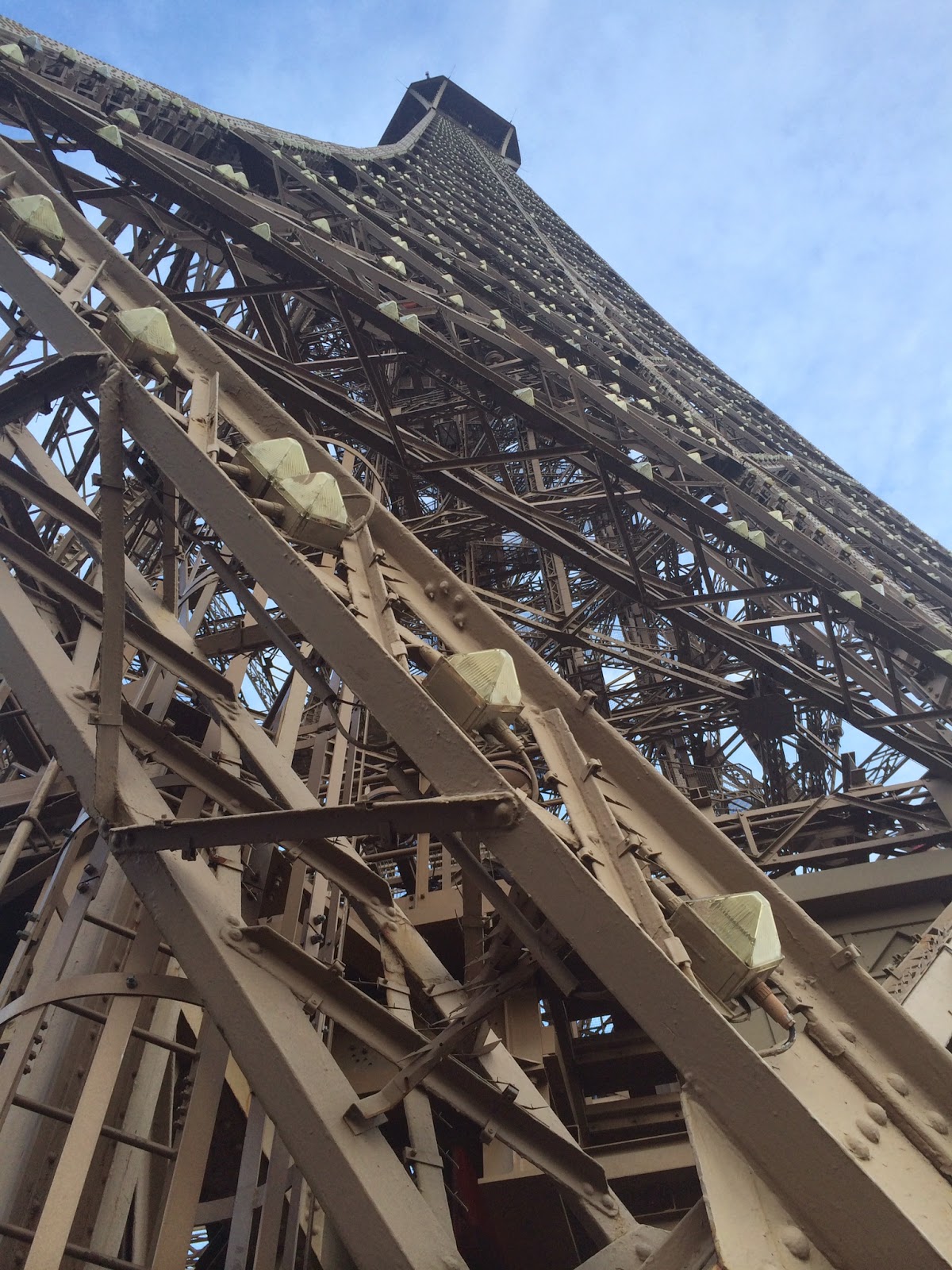
That said, at the Eiffel Tower we did encounter one episode that interested me. To get to the top of the tower you have two choices (three choices if you count buying a ticket ahead of time, which we didn't do). You can walk five hundred steps to the second stage of the tower and then buy an elevator to the top. Or you buy a ticket for an elevator that goes directly to the second stage and then buy that last ticket to the summit. After walking across Paris, we would have been very keen to just ride the elevator. Unfortunately we got into the wrong line. When we got to the ticket window, the woman there calmly explained that we could not purchase an elevator ticket, only a ticket to walk up the tower. She didn't say, "you can just walk across the square and purchase an elevator ride over there," she just left it at that. So we ended up walking. I'm not sure if a ticket taker at the Empire State building would act any differently but it's annoying when people in official capacities can't anticipate what's really being asked. Lauren brought up a comparison to Disney World where guides are instructed to always answer the question, "When is the 3pm parade starting?" with the time AND the location from which to see it best. Sometimes, and I see this in school too, people don't always know the BEST question to ask.
Another example. When were done with the tower, we walked to a local restaurant called the Le Campanella and did our best to decipher the menus (usually restaurants have detailed English menus, this one didn't). When I settled on a sausage dish, the waiter suggested another choice. "You won't like this one, it is very odd," he said. So I chose the beef stew and had the best meal of my stay in Paris. Maybe I would have liked the odd sausage but I honestly appreciated the fact the waiter was looking out for me. He knew something about my choice and decided to intervene to make sure my experience in his restaurant was as pleasant as possible. That's service.
Okay, so my attempt to sum up Paris in a single post has failed but that just means I get to write more tomorrow.


Comments